
Overview
For this project, our class partnered with Guild; a platform that helps employers provide their workers with access to tuition-free education, skilling, and career growth opportunities. Its model brings together companies, universities, and frontline workers, helping employees build new skills while also helping companies grow internal talent.
We were tasked with choosing a group of workers, conducting deep ethnographic research, and identifying the needs, mindsets, and tensions that shape how they think about education, career growth, and opportunity.
Our team focused on hardware store sales associates at companies like Home Depot and Lowe’s. Through shadowing, interviews, and in-context observation, we studied how associates navigate their day-to-day work, relationships, and future ambitions. The goal was to uncover insights that could help Guild design more resonant products, services, and messages for frontline workers whose paths to growth may not follow traditional corporate models.
TIME
4 Weeks
YEAR
2026
ROLE
Conducted and analyzed qualitative interviews
Synthesized research into key findings and central insights
Collaborated with teammates and stakeholders to translate human insights into clear strategic narratives and design opportunities

Our research began with direct observation and stakeholder shadowing. Across 8+ hours of fieldwork, we shadowed hardware store sales associates, conducted multiple interviews, and observed employees in their natural work environments.
We paid close attention to how associates interacted with coworkers, managers, customers, and the store environment during everyday work. What stood out was the strength of peer relationships. Associates consistently referred to each other by name, shared stories, warned one another about difficult situations, exchanged practical knowledge, and leaned on one another to manage the challenges of the job.
At the same time, employees often referred to supervisors and managers more generally as “management,” revealing a clear emotional distance between associates and leadership. Many associates described feeling unsupported by management, even while expressing deep trust in their coworkers.
Observation

Interpretation
Our research began with direct observation and stakeholder shadowing. Across 8+ hours of fieldwork, we shadowed hardware store sales associates, conducted multiple interviews, and observed employees in their natural work environments.
We paid close attention to how associates interacted with coworkers, managers, customers, and the store environment during everyday work. What stood out was the strength of peer relationships. Associates consistently referred to each other by name, shared stories, warned one another about difficult situations, exchanged practical knowledge, and leaned on one another to manage the challenges of the job.
At the same time, employees often referred to supervisors and managers more generally as “management,” revealing a clear emotional distance between associates and leadership. Many associates described feeling unsupported by management, even while expressing deep trust in their coworkers.

Direction
This led us to ask:
How might Guild help hardware sales associates pursue passions and career growth needs without sacrificing their interpersonal network?
From this question, we developed three design principles:
1. Facilitate career matches to different parts of the hardware company ecosystem to help associates explore non-linear career paths more suited to their passions.
2. Leverage tight-knit sales associate networks to create a shared learning platform that encourages career growth without the loss of peer support.
3. Create in-person opportunities for associates to workshop career goals together so they can receive guidance and encouragement from trusted peers.
Solution
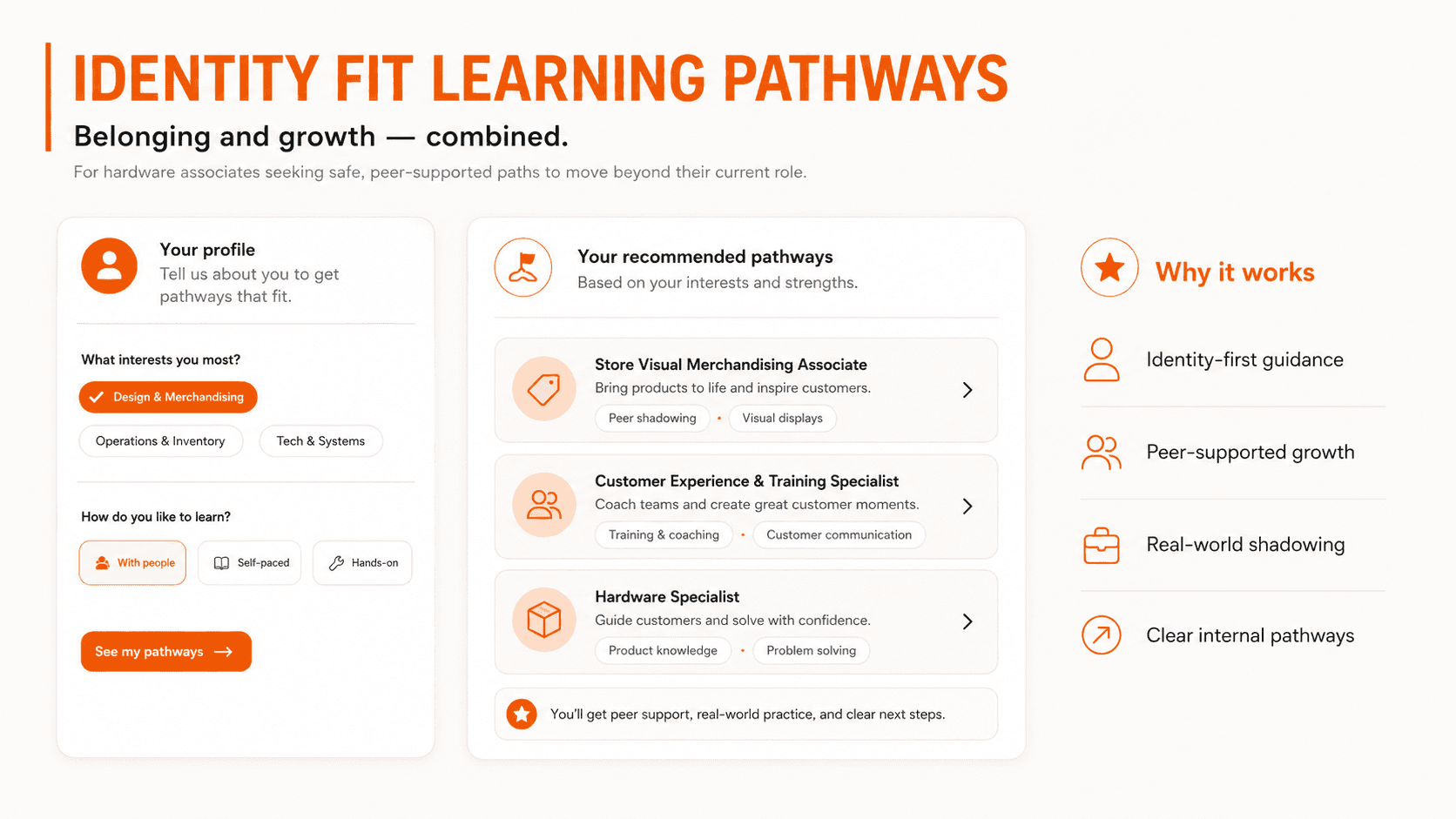
Identity Fit Learning Pathways:
A digital learning experience that helps associates connect their personal interests, strengths, and identities to possible career paths within the company ecosystem. Instead of presenting growth as a single upward path, this tool helps employees imagine lateral and non-linear futures that feel more aligned with who they are.
Friend Cohorts for Guild Academy:
A shared learning feature that allows associates to move through Guild Academy with coworkers they already trust. Rather than learning alone, employees can form cohorts, track progress together, and encourage one another as they work toward career goals.
Group Career Consulting Circle:
An in-person workshop model where associates explore career pathways together in small peer groups. These sessions would help employees turn online learning pathways into real career conversations, while preserving the social trust and support that already exists among coworkers.
Together, these solutions aimed to make career growth feel less isolating, more personal, and more connected to the relationships that associates already rely on.